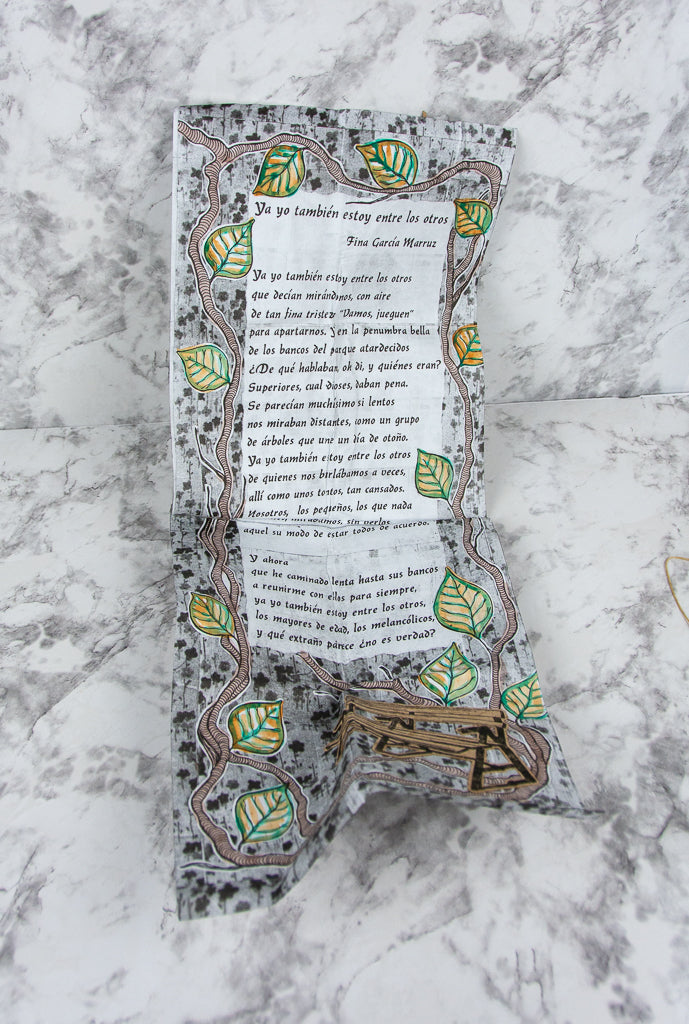
(ARTIST’S BOOK). MARRUZ, Fina Garcia. Ya yo también estoy entre los otros.
(ARTIST’S BOOK). MARRUZ, Fina Garcia. Ya yo también estoy entre los otros.
Couldn't load pickup availability
Handmade in Cuba
(ARTIST’S BOOK). MARRUZ, Fina Garcia. Ya yo también estoy entre los otros. (Matanzas, Cuba: Ediciones Vigía, 2014) Single sheet, folded and tied with string. (Sheet measuring 535 x 212; folding into box measuring 144 x 113 mm.) No. 144 of 200 copies. Housed in a handmade paper box embellished with fabric scraps, a leaf, and paper with text and illustrations. Photocopied paper sheets glued together, with hand-colored vine border, and printed craft paper cut-outs glued down. Small closed tear at lower edge, otherwise fine.
A lovely tribute to one of Cuba’s most celebrated poets, using burlap, leaves, velvet and recycled paper.
Fina García Marruz (1923-2022) was a celebrated Cuban poet and the winner of numerous awards, including the National Prize for Literature in 1990. The present work, made in honor of the poet during the "Semana de Autor" organized by Casa de las Americas in 2014, features her poem titled "Now I too am among the others." In reading the poem, we learn that the "others" here refers to the world of adults, and that the speaker, no longer a carefree child, has realized that she is now one of them. Designed and illustrated by Elizabeth Valero Molina, the broadside is folded, wrapped in string, and housed in a handmade box, as if trying to preserve something ephemeral yet very precious – perhaps a metaphor for childhood itself. Like other Vigía productions, this work has a wonderful handmade aesthetic and incorporates a variety of materials and textures.
Ediciones Vigía was founded in 1985 by Cuban poet Alfredo Zaldívar, and book artist Rolando Estévez, who became the artistic director of the press. According to an interview with Estévez and Zaldívar published in the Michigan Quarterly Review, "Ediciones Vigía emerged out of the need of a group of artists of the city to see their work, which they valued as literature, in print. We did not have a preconceived idea about what the volumes would look like. Our resources were scarce: a mimeograph machine that someone from a press was able to lend us, and a typewriter -- also borrowed -- because we owned neither. These are the only two machines we have used in the history of Vigía. More than anything, we use our hands and our imagination." For 40 years Vigía has maintained this spirit of independence and "make do" attitude, crafting its limited editions from a variety of items that include recycled materials such as fabric scraps, cardboard, yarn, and even sawdust, as well as mimeographs, prints, and paintings. Each book is constructed by hand and thus unique. To quote Zaldívar again, "They are exclusive editions; to own a Vigía volume is somewhat of a privilege." (1028)
Further reading: Behar, "Handmade in Cuba: Rolando Estévez and the Beautiful Books of Ediciones Vigía"; Alegria, "Vigia: The Endless Publications of Matanzas," in Michigan Quarterly Review: Vol. 33, No. 4, pp. 829-35.