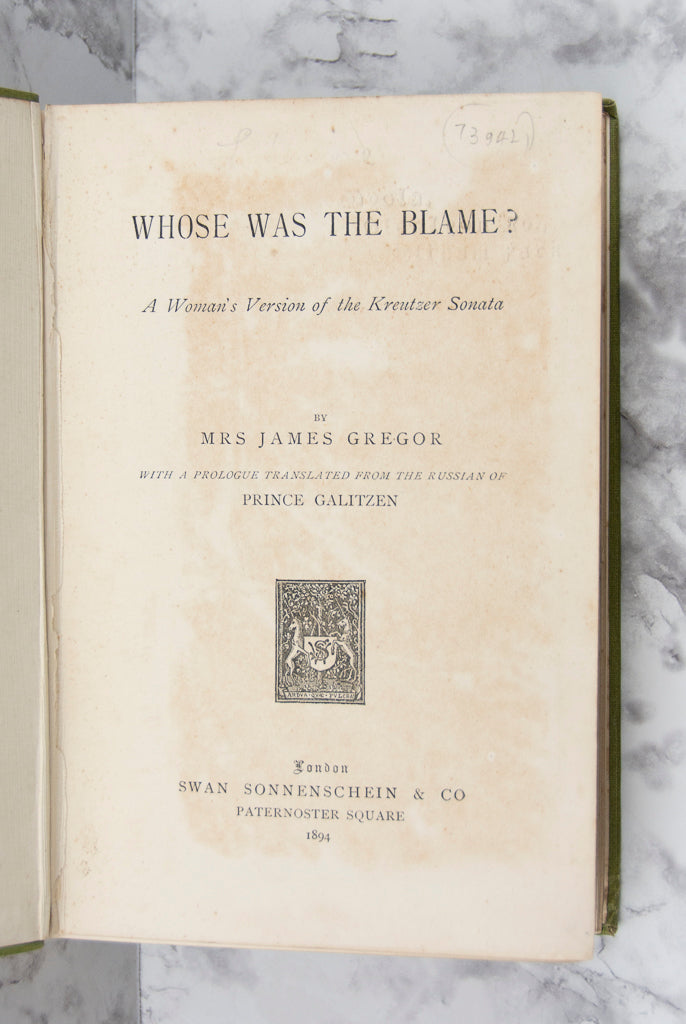
GREGOR, Mrs. James. Whose Was the Blame? A Woman's Version of the Kreutzer Sonata.
GREGOR, Mrs. James. Whose Was the Blame? A Woman's Version of the Kreutzer Sonata.
Couldn't load pickup availability
Rebuking Tolstoy
GREGOR, Mrs. James. Whose Was the Blame? A Woman's Version of the Kreutzer Sonata. [bound with] MACHEILD, Alec. A Question of Casuistry. (London: Swan Sonnenschein & Co., 1894) [ii], 174; [iv], 236 pp. (188 x 130 mm.) First Edition, later issue(?). Publisher's green cloth, black botanical designs on covers and spine, gilt titling. Title and following leaf with blind-stamp of "Myola / Glenlyon Rd. / Eltham Park." Light wear to cloth, one corner bruised, lacking front free endpaper, hinges exposed in a few places, light foxing to fore edge, but very clean internally. A very good copy.
An impressive proto-feminist response to Tolstoy's infamous "Kreutzer Sonata," told from a woman's point of view.
Leo Tolstoy's novella "The Kreutzer Sonata" caused quite a sensation when it was first published in Russian in 1889. The controversial work centers on the character of Pozdnyshev, whose confesses to the murder of his wife based on his suspicion of an affair. The novella features frank discussions of sexual relations, attacks on the institution of marriage, and arguments for the ideal of celibacy. It was immediately censored in Russia, and the United State Postal Service banned the novella from being distributed in the mail (which, of course, made it all the more popular).
The present work is a contemporary response to Tolstoy's story, told from the perspective of a young woman who enters into an unhappy union with a man who is selfish and arrogant to the core. She first glimpses his true self on their wedding night, and then, she explains, "The relationship soon resolved itself into this: I ought to be cheerful--it was my duty. I ought to adore him, and when he had time he would be graciously pleased occasionally to accept the adoration." Her misery compounds day by day, ignored by her husband and by a society that tells her "she is truly faithful and good, for although she does not love her husband, she continues to look after him, to make his home comfortable, and to receive him with a joyful, happy face." When a young man enters the narrator's life, a man who is kind, gentle, and worthy of her love, her heart and soul cannot resist him. In the end, who, really, deserves the blame?
It is interesting to note that Tolstoy's wife, Sophia, wrote her own response to "The Kreutzer Sonata" titled "Whose Fault?" Though unconnected to each other, the two works share similar plots and challenge the view that the wife should be held responsible for a marriage's failure. Instead, the writers emphasize the husband's jealousy, selfishness, and lack of interest in his wife's inner world as primary factors, dooming their union from the start.
This copy seems to use the sheets from the first edition, but it appears with another work titled "A Question of Casuistry," and in a different publisher's cloth binding. We find no record of any other copy matching this description on OCLC or anywhere else online. (1019)