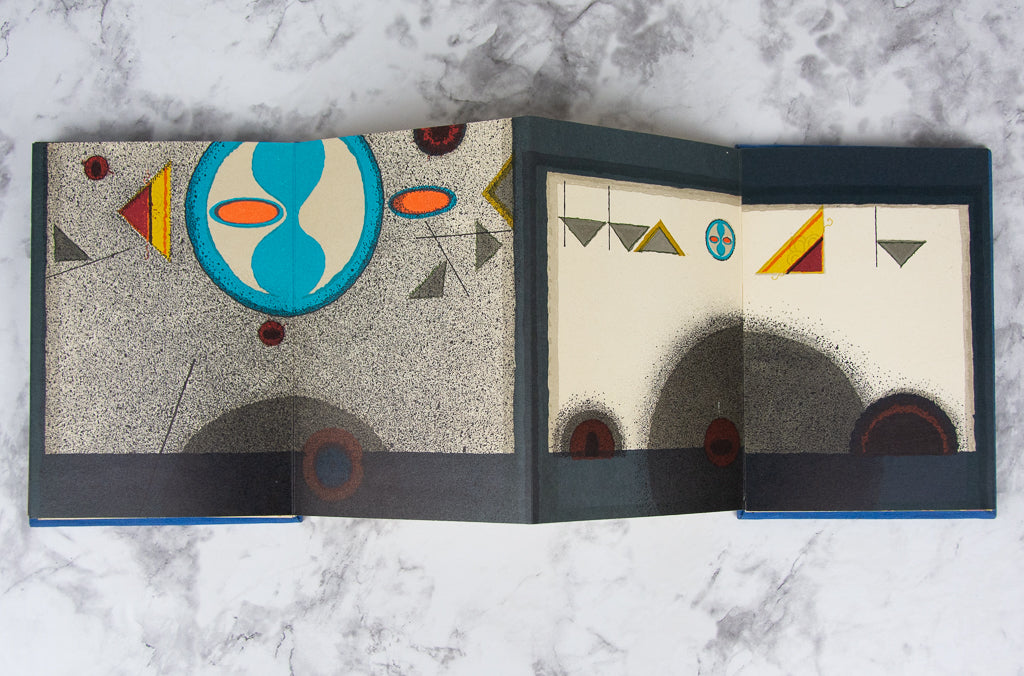
A Symbolist Cinderella
LAVATER, Warja. Cendrillon. (Paris: Maeght Editeur, 1976) [42] panels, folded accordion-style and attached to upper and lower boards. (160 x 112 mm.) Original blue cloth boards, upper board with printed paper label. In the original plexiglass slipcase. With 20 double-page color lithograph illustrations, and folding key inside front cover. Small scratches to slipcase, book in mint condition.
A wonderfully inventive artist's book that reinterprets a classic fairy tale as a series painterly symbols.
In this work, Swiss artist and designer Warja Lavater translates the familiar Cinderella story into a purely visual narrative. Each character, object, or idea is represented by a specific abstract sign as designated in the opening key. For example, a blue and silver dot for Cinderella; and two orange and blue ovals for the glass slippers. The story unfolds across the long, continuous fold-out pages, where the viewer "reads" the tale from left to right like a pictorial score. This work is one of several experimental visual books, or "Imageries," that the artist produced in the 1960s and 70s, each of which retells a classic tale using color-coded symbols and minimalist pictograms. A confluence of art, design, and semiotics, this work and Lavater's other "Imageries" are considered early examples of the modern artist's book, and continue to be fascinating examples of visual language and storytelling.
Lavater (1913-2007) studied at the School of Applied Arts in Zurich under Ernest Keller, and began her career designing logos, trademarks, and posters for various companies and organizations. Following her move to New York City in 1958, Lavater began experimenting with visual symbolism and narrative abstraction. Her first pictographic work was "William Tell," published for MoMA in 1962. (1037)