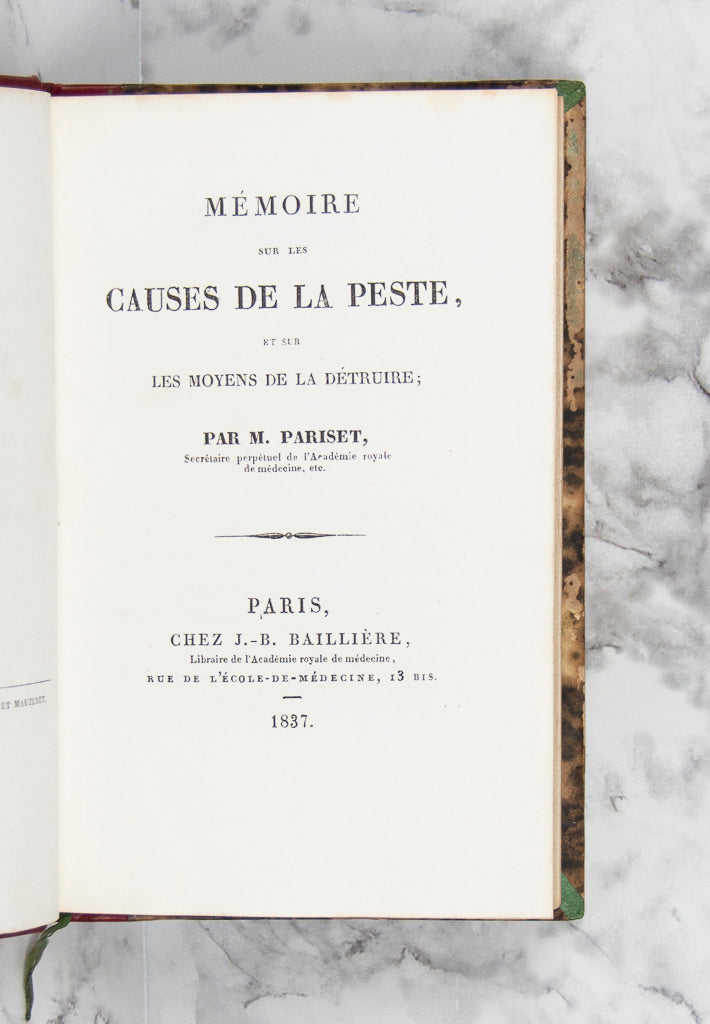
(PLAGUE). PARISET, Étienne. Mémoire sur les causes de la peste, et sur les moyens de la détruire.
(PLAGUE). PARISET, Étienne. Mémoire sur les causes de la peste, et sur les moyens de la détruire.
Couldn't load pickup availability
Don't Blame the Mummies
(PLAGUE). PARISET, Étienne. Mémoire sur les causes de la peste, et sur les moyens de la détruire. (Paris: Chez J.-B. Ballière, 1837) [iv], 224 pp. (160 x 102 mm.) First Edition thus. Contemporary quarter red morocco over marbled boards, spine gilt. Light scuffing and scratches to covers, contents with light scattered foxing, excellent condition overall.
A rare work theorizing the causes of frequent plague outbreaks in Egypt, part of a growing 19th century crusade to address endemic diseases and bring about sanitary reforms.
Arriving in Egypt in 1828, Pariset primarily focused his studies on Cairo and the Nile River Delta. His conclusions rested on the so-called "cadaveric virus theory" which blamed the spread on pestilence on the bad air, or miasma, produced by graveyards and rotting corpses. According to Kuhnke, "Pariset was revolted by the Nile valley graveyards where corpses were annually submerged and surfaced to float on the rising river. He theorized that Egypt must have been free of plague while the ancients practiced embalming and entombing corpses outside the flood area. When Christians substituted embalming for burial, they must have initiated the sixth-century plague pandemic. The Black Death also must have arisen in Egypt's delta, he said, 'because nowhere else in the world does one find . . . extended, flat land which is warm, humid and saturated with animal matter.'"
Although Pariset's theories on the causes of Egypt's plague outbreaks ultimately proved incorrect, Salzgeber credits him as "one of the few reporters of this expedition to emphasize the modernity of the organization of Eastern societies and their ability to manage social problems." Pariset also drew attention to issues of public hygiene, and recommended measures such as vermin extermination, separating humans and domestic animals, and quarantine to combat the disease. The present work first appeared as an extract from the "Annales d'hygiène publique et de médecine légale" in 1831, and appears here as a separately published work for the first time.
Étienne Pariset (1770-1847) was a French physician and psychiatrist associated with the Bicêtre Hospital and the Salpêtrière Hospital where he treated the mentally insane. In 1819 he was appointed to the "Commission for the Improvement of the Condition of the Mentally Ill," and in 1822 was named the first permanent secretary of the Académie Nationale de Médecine. In addition to his work on the plague, Pariset also studied the causes of yellow fever in Spain, and founded the Société Protectrice des Animaux.
Further reading: Kuhnke, "Lives at Risk: Public Health in Nineteenth-Century Egypt," pp. 69-71; Salzgeber, "Biographie d’Etienne Pariset: médecin des aliénés et médecin des épidémies au XIXe siècle" (2006 dissertation, University of Lorraine). (1119)