VALLOTTON, Félix (Artist). Crimes et Châtiments.
VALLOTTON, Félix (Artist). Crimes et Châtiments.
Couldn't load pickup availability
The Rare Special Issue with Detachable Lithograph Prints
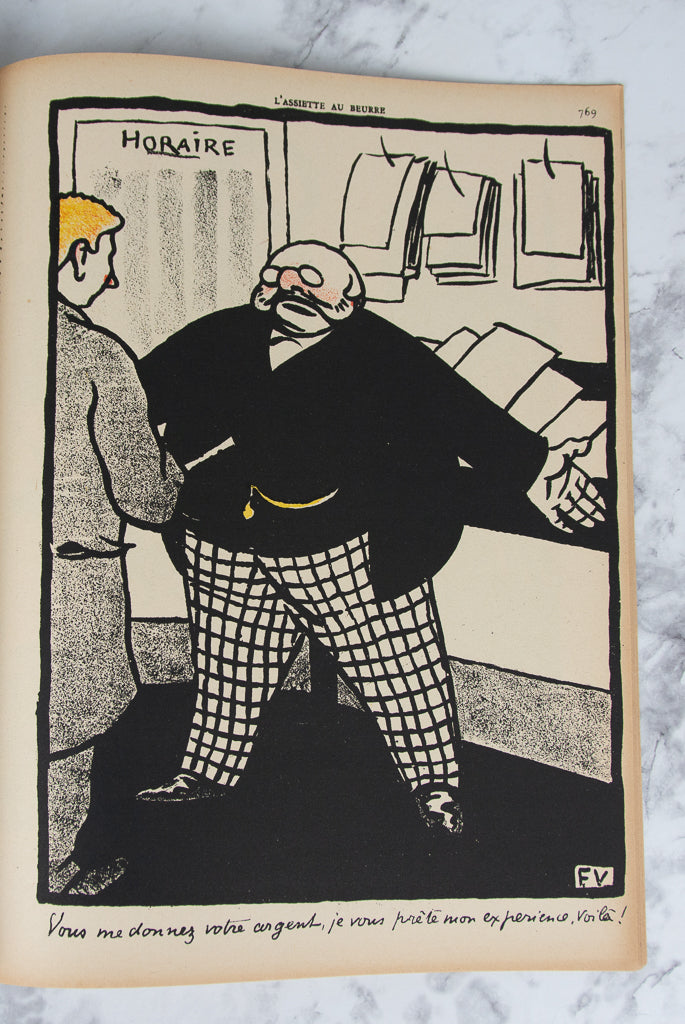
VALLOTTON, Félix (Artist). Crimes et Châtiments. (Paris: L'Assiette au Beurre, 1 March 1902) [22] leaves. (315 x 445 mm.) Original color lithograph front wrapper, lacking the rear printed wrapper. Each leaf with a full-page color lithograph on recto. The 50 cent price crossed out and increased to 70 cents. Light edge toning, small nick to edge of one leaf, final two leaves each with a faint crease, but an extremely fresh and well-preserved copy.
One of the most sought-after issues of this renowned periodical, composed entirely of satirical illustrations by a prominent post-Impressionist artist.
The French weekly magazine "L'Assiette au Beurre" originally ran from 1901-12, and was renowned for its radical political satire and striking graphic design. It employed leading avant-garde artists and illustrators of the day, and fearlessly mocked figures in authority as well as taboo topics such as prostitution, asylums, and alcohol. Unlike most illustrated journals of the time, its issues often revolved around a single theme and were illustrated by a single artist, allowing for a cohesive voice with visually bold critiques, making it one of the most important periodicals of the entire Belle-Époque.
This special issue of "L'Assiette" is titled "Crime and Punishment," and consists of 23 lithographs (including the front cover) with short captions, illustrated entirely by the avant-garde artist Félix Vallotton. In it he mocks the criminal justice system as well as all forms of punishment, from the school master beating his pupil, to police brutality. In addition to being longer and more costly than regular issues, this installment is also unusual in that each lithograph is perforated for easy detachment--presumably for the purpose of framing.
Vallotton (1865-1925) was born in Switzerland and studied at the Académie Julian in Paris, where he became a member of "Les Nabis," a group of young post-Impressionists committed to breaking away from rigid academic notions of art. Vallotton gained early fame for his bold woodcut prints, which were heavily influenced by Japanese Ukiyo-e. According to the Hammer Museum, "Woodblock printing allowed Vallotton to evoke the aesthetic linear qualities of ukiyo-e while including the popular post-Impressionist subject of life in the city during rapid growth and change due to industrialization." The present work is a fantastic example of his unique style, using bold shapes and flattened surfaces to create scenes infused with theatricality and tension. (1128)